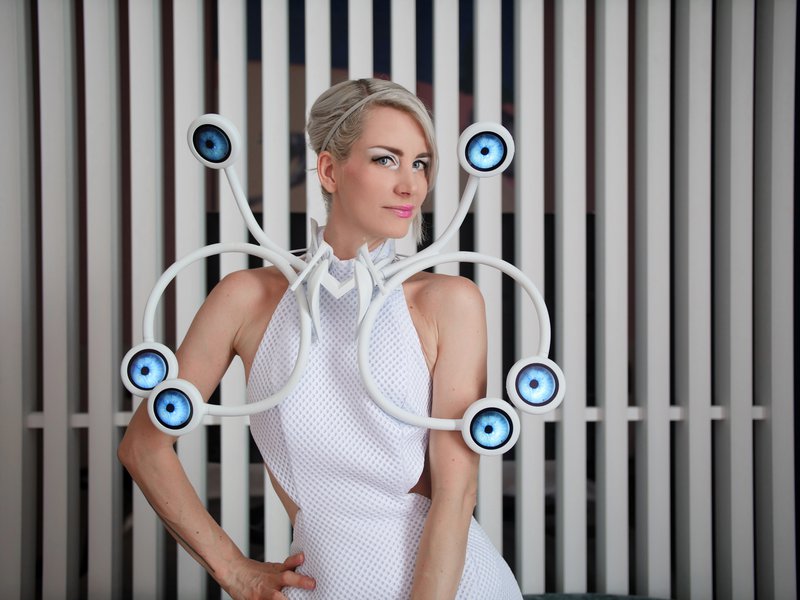
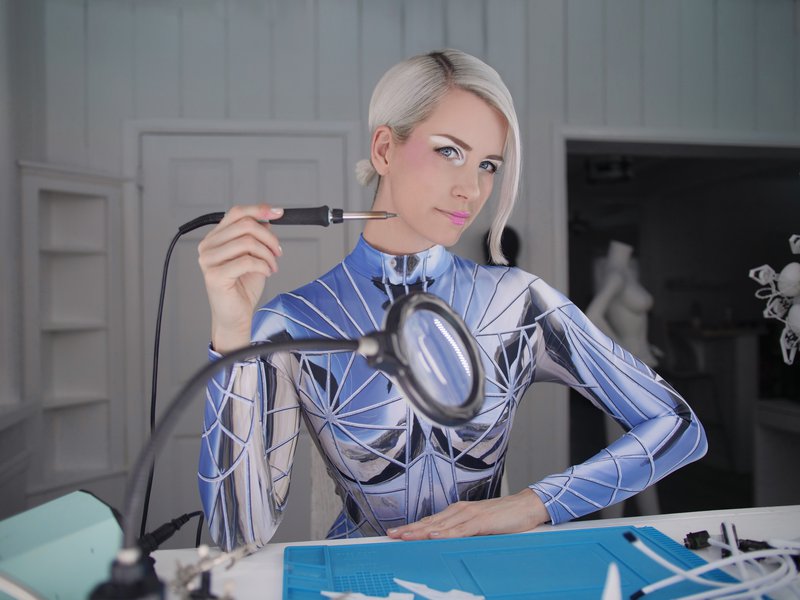
“With the rapid advancements in Robotics, AI and Emerging Technologies, we’ve seen design processes become more sophisticated and experimental, pushing the boundaries of what’s possible,” says FashionTech designer, engineer and innovator, Anouk Wipprecht.
When Teulo caught up with Anouk in 2021, she was based in Miami, Florida (USA) and was taking inspiration from the global, post-pandemic context. “Much of the world was still adjusting to a post-pandemic reality,” she reflects. “For me personally, the shift wasn’t as disruptive as it was for many others, since my work has always relied heavily on digital tools and remote collaboration. My practice continued to evolve quite naturally.”
After more than 22 years in FashionTech, Anouk is still genuinely excited by the field and how quickly it is changing. Her focus is on new ways that custom pieces can be embedded with electronics and run on machine learning, creating responsive garments that truly interact with the body and the environment. “I’m also exploring neuro-sensing and biometric technologies to give garments an almost ‘alive’ quality, reacting to emotions, movement and more,” she says. “On the methodology side, I’m drawn to more modular and circular design principles, finding ways to make these high-tech garments more sustainable, upgradable and adaptable over time. Ultimately, the electronics themselves are only part of the story. What excites me most is how these technologies allow us to rethink the relationship between humans and clothing, making tech-fashion more experiential, expressive and intelligent, and making us more connected through the technologies that we interface with.”
“With the rapid advancements in Robotics, AI and Emerging Technologies, we’ve seen design processes become more sophisticated and experimental, pushing the boundaries of what’s possible,” says FashionTech designer, engineer and innovator, Anouk Wipprecht.
As technological capabilities increase at speed, Anouk says that the creative possibilities feel almost limitless. “Design itself has become bolder and more expressive, and even from an architectural and structural perspective, there are far more avant-garde projects coming to life. People are increasingly seeking unique, daring ways to express themselves through what they wear. This surge in innovation has led to a significant influx of activity in the FashionTech space; everything from everyday garments to elaborate stage wear is being reimagined.
“I’ve also been collaborating with fashion, design and engineering schools to integrate FashionTech into their curriculums. It’s an exciting hybrid field that doesn’t just inspire creativity but also serves as a powerful gateway to technology. For example, not every young woman may be drawn to building drones or cars, but many are excited by the idea of smart textiles and wearable tech. FashionTech can be a fantastic entry point for bringing more women into STEM fields through something that feels familiar and expressive.”
Last year, Anouk moved back from the US to the Netherlands, where she is now based near TU Delft, one of Europe’s leading technical universities. “This move has opened up new opportunities to connect with clients and companies but also more teaching and engaging with students. It’s been refreshing to be part of a community where conversations around sustainability, policy and privacy in technology are much more structured and forward-thinking. It feels like here people are setting strong, healthy standards for how technology can be integrated responsibly into society.”
In her lectures, Anouk works to provoke curiosity and expand the ways that her students think about fashion, technology, and the body. “I try to do more than just teach tools or techniques. I encourage my students to look at garments not only as objects of expression, but as active interfaces: systems that can sense, react and communicate. A big theme I explore is the merging of the biological and the technological. For example, what happens when the body itself becomes the platform? How can fashion act as a medium for emotion, interaction, protection, or even cognitive support? I push students to imagine speculative futures where clothing is intelligent, responsive, and deeply integrated with human experience.
“At the same time, I emphasise responsibility. Conversations around ethics, privacy, sustainability and inclusivity are just as important as engineering skills. It’s not enough to make something that ‘works’. We have to ask who it’s for, what it communicates, and what systems it participates in. This reflects back to my own study of Interaction Design, examining the relationship and dialogue between a user and a product or technology. I also like to break the barrier between disciplines. I work with students from fashion, design, engineering, robotics and beyond, because innovation happens at the edges where these worlds collide. An interdisciplinary approach is absolutely essential. You need a solid understanding of electronics and engineering to create safe, reliable systems that function close to the body. But that’s just the foundation. These systems also need to look compelling through thoughtful design, feel comfortable through well-crafted fashion and material choices, and respond intuitively through a layer of interaction design that often borrows from psychology and human behavior.”
The future of the industry is one where fashion evolves beyond something we wear and is truly integrated into our lives, Anouk says. “Fashion will become something we interact with: intelligent, sensory interfaces that live on our bodies and act as extensions of ourselves. Garments will become active participants in how we sense, move, express and connect with the world. In my work, I explore this through exoskeletal structures and smart textiles that function like co-processors, reading biometric signals or environmental cues and responding in real time. I’m especially interested in ‘emotional garments’ that can help us regulate or express inner states, like stress-responsive pieces or designs that visualize brainwaves. Fashion, in this sense, becomes a hosted system on the body - a platform for cognitive, emotional and physical augmentation, and a shift from passive aesthetics to active, intelligent design.”
As autumn arrives in the northern hemisphere, Anouk finds herself settling back into the studio. “This is always a productive and creative season for me. I’m currently finalizing my new Spider Dress alongside several new pieces that will be released soon. This coming year is filled with exciting projects - from exploring cooling technologies in garments for Saudi Arabia (LEAP 2026) with my students, to developing all kinds of fun and strange things including R&D on spacesuit technologies, smart glasses, working with a brain-computer interface for dogs, female exoskeleton designs, and even a possible techno-polished theater production. What excites me most is how diverse these projects are from an engineering perspective. The field is expanding rapidly, and with electronic components becoming smaller, smarter, and more powerful than ever, the creative and technical possibilities keep growing. That’s the true joy of working in FashionTech; the canvas just keeps getting bigger!”
To learn more and connect with Anouk, visit https://www.anoukwipprecht.nl/, follow her on Instagram and LinkedIn, and catch her at the FashionTech Meet-Up in Melbourne on the 4th of December.