This solutions-focused approach has led Escea on a huge product development journey since Teulo last caught up with Richard in 2022. “One of the big changes over the last few years has been international growth, primarily around our brand newbrand-new 3D holographic Escea Electric fire. The pipeline for that product has been about five years, and they’ve been on the market now for the last 2 years . We’ve added the U.S., Canada, Europe and England to the dealerships we’re working with internationally, and our product development reflects that. We’re working with fires fit for New Zealand but that also have international style and progressive design inspired by what’s happening overseas.”
“You can take a freestanding fire and drop it anywhere in your design.”
“We set out to solve problems no one else can see,” says Richard Miller, Architectural Lead, Escea.
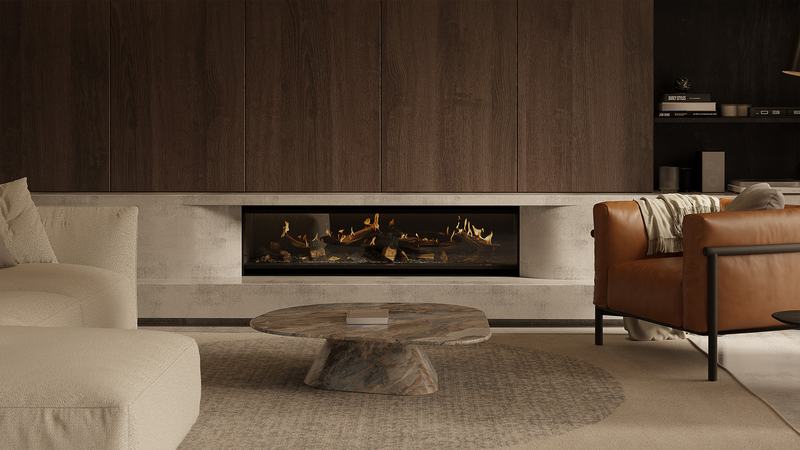
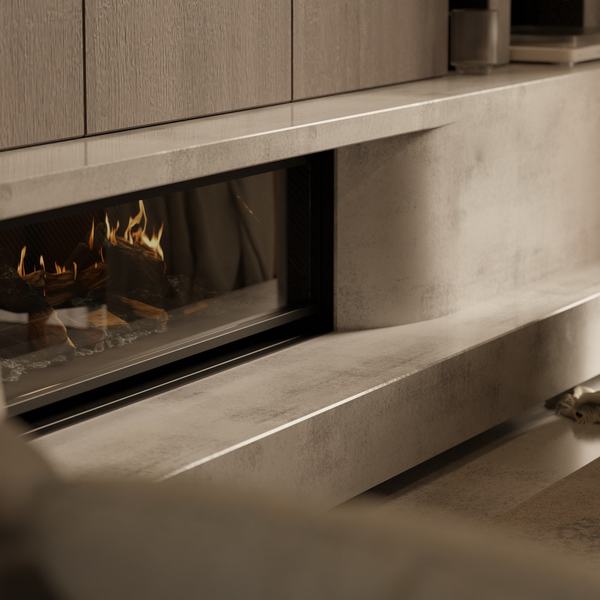
Richard describes the Escea Electric as best in category. “It’s very special, especially for Kiwis whose experience of electric fires is the twinkly little log at their grandma’s house. The core of the technology is a beamsplitter glass where a 3D illusion creates an immersive experience of the flame that’s quite hypnotic and engaging. They’re a lot more romantic than a heat pump which is purely functional. With an electric fireplace, you get warmth and atmosphere. It’s designed to be looked at, not just felt.”
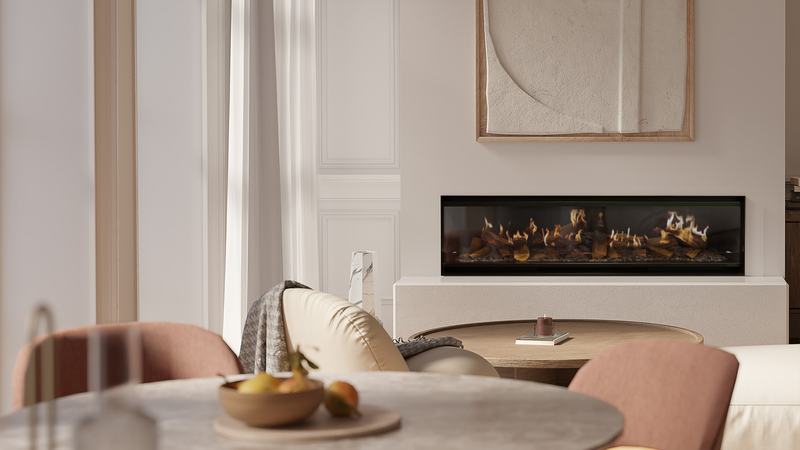
The Escea Electric is the only fire of its kind manufactured entirely in New Zealand, and its imagery was produced by Escea’s first-ever artist hire, Richard says. “For what is essentially an engineering company, it was very unusual to bring an artist on board, but we wanted to put a lot of effort into the flame and log design and colour. This is how we’ve been able to get the realism, the emotional feedback and engagement that we have. It’s already on its third generation after only two years, with product improvements and iterations of the flame and log sizes and shapes. There are four different flame patterns to give you the effect of smoke, sparks, and embers, with settings that get more dramatic as you scroll through.”
MODO Architects
Photographer: Ben Hosking
Escea has also been busy evolving their gas and wood fires over the last few years, Richard says, with a fairly even split now on the fuel types they offer. “We’re known as a gas fire company, and that’s something we still do extremely well internationally, but we’re relatively new in indoor woodfires. In the last 24-36 months, we’ve stepped wholly into the woodfire category and fully integrated that into our offering.
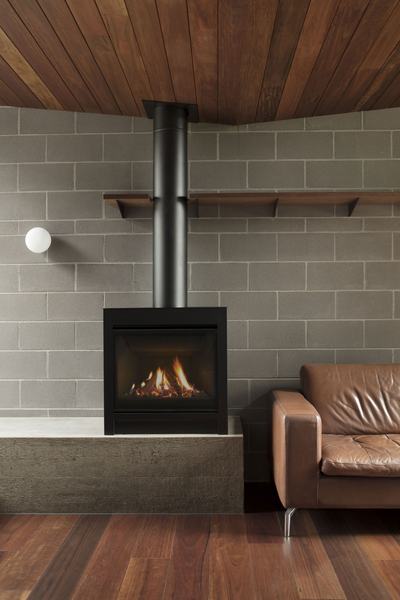
“We provide a range of freestanding fires that sit on a plinth, all with the same beautiful steel wrap, so you can pop them on an architectural plan and ask your client later what type of fuel they want. This reflects the more diverse choices people are making now on their fuel types. Our direct vent woodfire systems means that you can place them anywhere, not just on an exterior wall, because their air intake is brought in directly to the firebox without breaking the seal and bringing cold air into your home. Suddenly, what seems like a boring feature opens up a world of amazing design possibilities.”
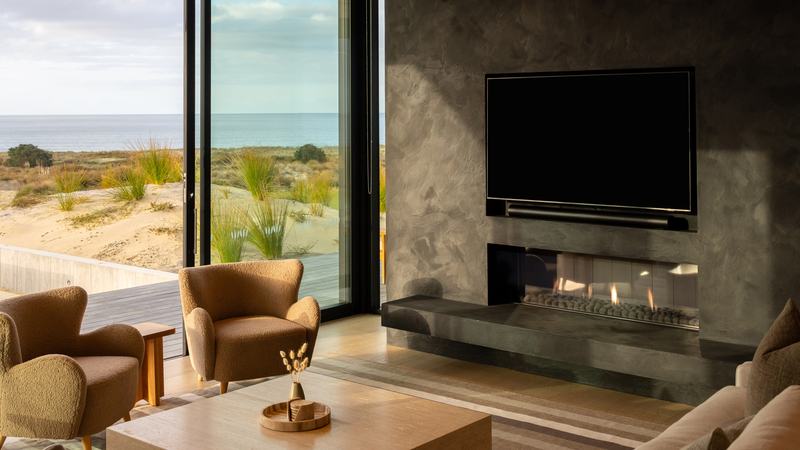
Photographer: Jono Parker
“We’ve also added a range of low-emission (LEB) and ultra-low-emission (ULEB) wood burners, which are increasingly needed in New Zealand’s clean-air zones. The LEBs produce less than 1.5gr of soot per 1kg of wood burned, with the ULEBs producing half of that at about 0.7gr. We have a massive woodfire pollution problem in New Zealand, with an enormous spike in toxic air pollutants in the winter months. Whether you are required to or not, the responsible thing for you and your neighbours is to put in a ULEB for your primary combustion burner. They are really beautiful fires with amazing heat output and they’re super clean. Combining the ULEB technology with the direct vent technology is the magic bullet for wood fireplaces.”
Escea’s signature gas fires have been updated too, with the whole range now offering Wi-Fi connectivity and increased efficiency. “We have improved wall lining temperatures, deeper wall lining options, more frameless trims, and a more efficient use of gas - if you’re going to use a natural resource, the least you can do is use it as effectively as possible. We’ve also grown the range of shapes with corner and peninsula models and improved the detail and finish.”
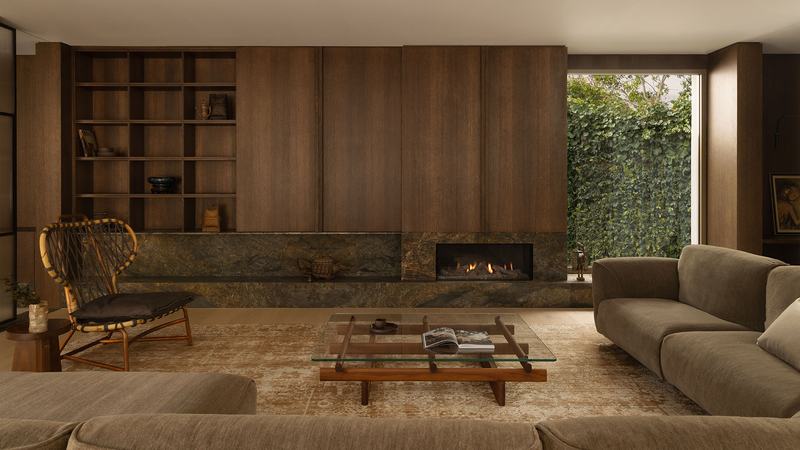
Photographer: Timothy Kaye
Better housing standards and higher-density developments are driving big shifts in the home heating space, trends that Richard expects to continue in the years ahead. “The required heat loading for new H1 or Passivhaus builds is getting smaller and smaller all the time. A 9kw or higher gas fire appliance is getting to be problematic in these spaces because of how well insulated they are. Just a teaspoon of energy will keep you warm in that environment, which makes a 1.5kw or 3kw electric heater a great option. As New Zealand transitions to medium-density housing, there’s going to be a lot more electrical appliances specified in homes. In the gas fire space, we’re seeing demand for dramatic design, but with the convenience that people are looking for. And across the range, we’re seeing a bigger drive for safety - mesh on gas fires and heat shielding - particularly for spaces like retirement villages and apartments.
“The work I do is in greater demand as we see designers really pushing the limits of what they can do with these beautiful products, and also with the rise of social media influencing what people want to buy and, in some cases, providing misleading, AI-generated product recommendations that don’t exist or won’t work in practise. There’s an increasing requirement for strong customer service to counteract that.”
One of the core Escea principles is that waste is wrong, Richard says, and this is something he stresses with his clients. “We are really committed to energy efficiency, and we believe that efficient appliances just make sense, whether that’s in a new build or a renovation. When homeowners and designers are selecting an appliance that’s going to be in their home for the next 20 years or more, it’s important to seriously consider the impact of their choices, and Escea can support them in doing just that.”
To learn more and connect with Richard,check out www.escea.com, view their gallery and Instagram
