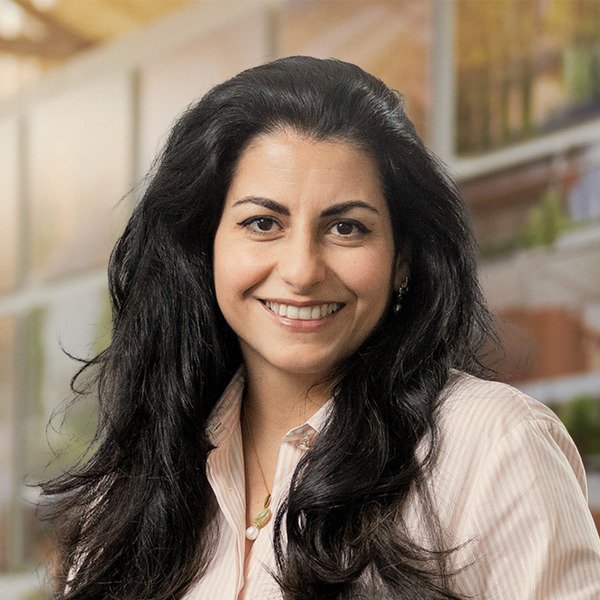
With a background that spans architecture, applied research, innovation, and environmental design, Golnaz brings a breadth of expertise to RIOS projects at every stage of design and delivery. “My job is to do a deep dive, understand what the most regenerative approach is, and determine how we can improve the overall outcome,” she says. “In the early design phase, I am typically looking at aspects like climate and microclimate; later I focus on materials, whole-life carbon, and façade performance.”
Golnaz has been with RIOS’s London-based team for just under a year, and in that time has strengthened the tools, resources and systems they use to create top-performing buildings worldwide. “What really attracted me to RIOS is that a third of the employees are landscape architects; it’s a global, multi-disciplinary practice that is inclusive of how both nature and improved design process can positively impact the outcome.
“A big focus for me is leading our Climate Action Committee, which currently includes 24 sustainability champions working at all levels of the business. We set and track strategic goals and examine ways that we can improve our commitments and better align with international frameworks, including the United Nations’ Sustainable Development Goals. We have put in a huge effort to track the operational data of a broad portfolio RIOS projects so we can better understand how they’re performing. We work very closely to support our team with the tools they need to run those analyses and quantify their impact.”
It was during her studies in Italy that Golnaz found her passion for climate resilience and sustainable, data-driven design, but it was her family that first provided the inspiration, she says. “My mother was always very close to nature. She’s one of those people who can go for a walk in the mountains and see a type of native plant or flower and tell you what it is and what benefit it provides. She never needed an alarm clock because she was attuned to the sun.
“I moved from Iran to Italy to study architecture, which was my passion, but my focus initially had nothing to do with the environment or sustainability. It was in the early days of reflecting on my PhD research topic that this changed. That came after a conversation with my cousin, who talked about a house she was working on in a hot, dry climate and how they were researching passive cooling systems and ‘badgir’ wind towers, a traditional architectural element that can capture wind and naturally bring a cooling effect into the space. I knew nothing about it, but I searched for information and started talking with my supervisor, and he thought it was interesting. There is a similar climate in Sicily, with similar architectural elements that we could compare and study. I ended up doing two months of research and publishing an article about it in the university journal. I started my research path on a completely different topic, but my supervisor then asked if I wanted to focus on sustainable and environmental design. And that was it. Everything started from there, and it progressed into my final PhD thesis.”
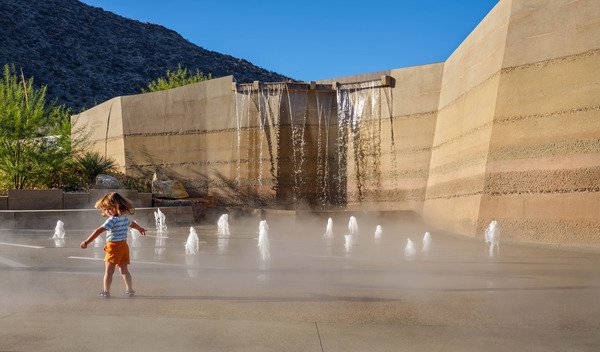
RIOS Palm Springs City Park
After completing her studies, Golnaz moved to London and spent eight years with Foster + Partners doing applied research to support their skilled multi-disciplinary team. “They had experts from all fields - not just architects but specialists like mathematicians and mechanical engineers. I learned so much there about data and analysis and how we can shape facades, improve performance, and collaborate to solve complex design challenges.”
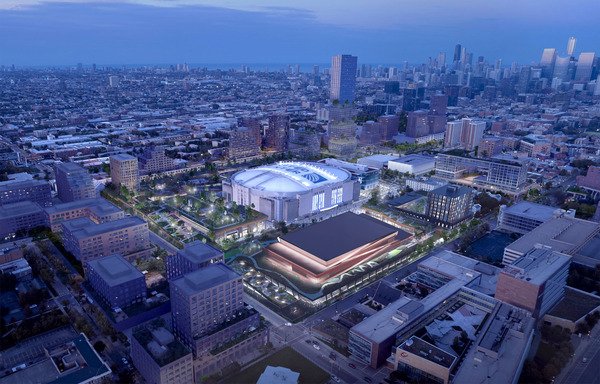
Golnaz has brought these learnings to her work at RIOS by strengthening how the team embeds climate-responsive design, whole-life carbon thinking, and nature-based strategies. RIOS’ portfolio includes The 1901 Project on the west side of Chicago. This award-winning project “combines state-of-the-art urban design with a focus on ecological revitalisation, social cohesion, and long-term resilience. At its heart is United Centre, a traditional sports stadium, but the reimagined vision connects various parts of the city, with huge areas of the historical carparks transformed into extensive green space and recreational areas to support the community.”
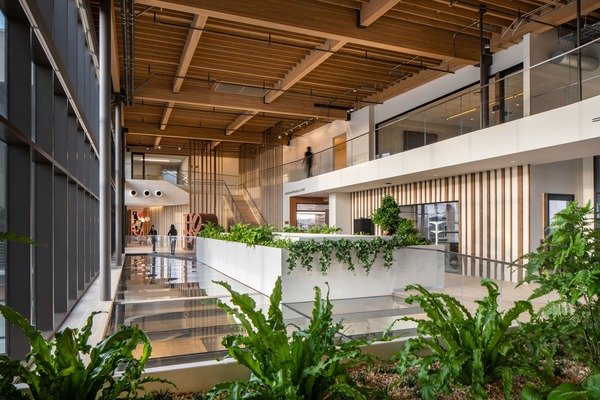
Where 1901 highlights RIOS’s leadership in urban regeneration, 42XX in Los Angeles showcases their work with sustainable materials and building practices, namely mass timber construction. “42XX is one of Los Angeles’s largest mass timber office campuses; it brings together hybrid structural systems, carbon reduction strategies, and biophilic design to reshape the modern workplace while setting a new benchmark for sustainable urban development.”
Golnaz is excited to bring her deep expertise and international perspective to New Zealand later this year, when she joins Teulo Talks Live in August. “I’m always looking for new ways to scale my impact, and coming to New Zealand will present a unique opportunity for knowledge transfer with the local industry. In my Teulo Talks session, I will be showcasing some case studies and talking about how regenerative design principles can drive sustainable innovation. I will also look at data-driven and evidence-based design, particularly in complex contexts where we might have competing demands such as a desire for more sunlight which then also brings too much solar heating into a space, or triple-glazing that also adds embodied carbon.”
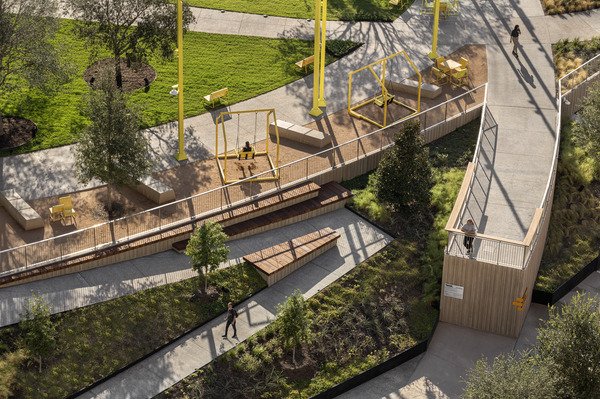
RIOS Houston First Lynn Wyatt Square for the Performing Arts
The real key to environmental, data-driven design is behaviour change, Golnaz says, which can be achieved through a transdisciplinary approach. “You have to create a clear vision and then leverage system changes and technological advancements to look at designs in a different way. The old intradisciplinary approach of doing your part and then giving it away to another team to do their part isn’t working any more. We need to include every expert at the table and view one discipline from another in order to unify the vision around one imperative, climate action.
“As an architect, I need to have expertise around performance; if you’re the engineer, you need to come to me with some understanding of materiality and design. We need a bigger overlap and a very clear framework because it’s not enough now to simply be sustainable. We need to be moving into a truly regenerative space where we’re bringing positive aspects with the design - creating more energy than we need, having positive effects on the local environment, or bringing wealth and benefit to the community. To achieve that as an industry, we need to set ego aside and start with the people who live in these buildings and communities, understanding what they value, what they need, and what will genuinely improve their lives. That’s how we can really be of service to others.”
To learn more and connect with Golnaz, visit https://www.rios.com/, follow her on LinkedIn, and keep an eye out for tickets to her upcoming Teulo Talks Live in NZ.
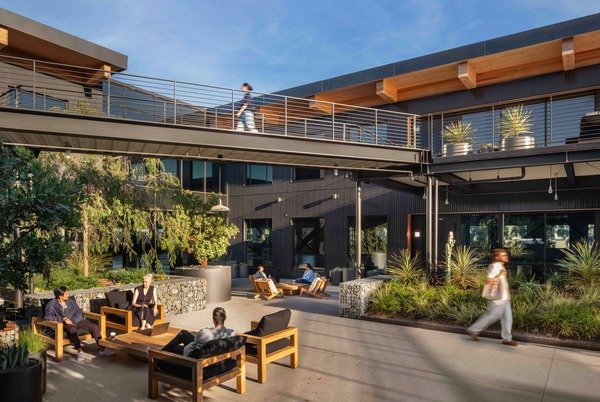
RIOS Bradmore Marina Del Rey