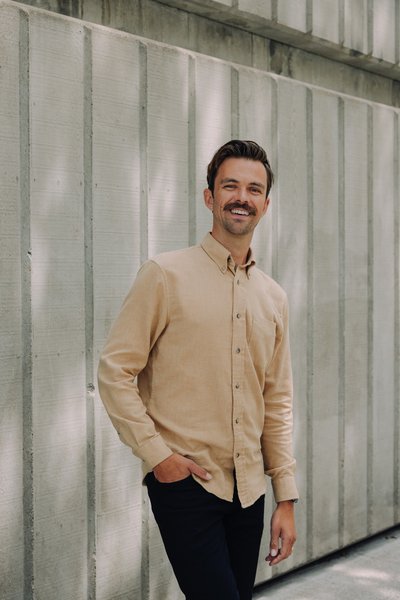
It was Principal Greg Faulker’s deep understanding of and connection to the landscapes of California that first drew Dan to the practice, where he has been for the last five and a half years. “We take inspiration and direction from the sites - finding ways for homes to last as long as the environments around them. This is conveyed through simple, strong, singular gestures that are successful because they consolidate the floorplan in a way that’s easy to understand, read, and move around in.
“Beyond that, materiality is where our work really shines. We value materials that are long-lasting and don’t require a lot of maintenance, such as concrete and steel. We test them by leaving them out in the sun for months and exposing them to snow, rain, and extreme temperatures. This is how we know that they will be resilient and last, even in challenging environments.”
Faulkner Architects projects are most often found in the dry and temperature-variable climates of the California hills, or on the coast where they’re exposed to strong winds and sea water. Making sure that the design works for the site location is a huge part of the practice, Dan says. “We start with the obvious - preserving landscape features that need to stay, like trees that are providing critical shade or wind protection. And then it’s all about the orientation. It sounds very simple, but it can so easily be overlooked. We spend a very long time on that and talk about it constantly throughout the design process.”
“Beyond that, materiality is where our work really shines. We value materials that are long-lasting and don’t require a lot of maintenance, such as concrete and steel. We test them by leaving them out in the sun for months and exposing them to snow, rain, and extreme temperatures. This is how we know that they will be resilient and last, even in challenging environments.”
The practice is fortunate to have like-minded clients who prioritise the things that Dan and his team find most important in creating architecture, he says. “It tends to be a pretty easy marriage for us, with clients who understand the need for thoughtful site analysis and attention to detail. But we do a lot of teaching too; there’s a big storytelling component to explaining how a terrace should feel in the summer time. When we get a brief from a client, we don’t just design it and throw it back to them. It’s a collaborative process that can take maybe three years, with input from a lot of smart people. That’s exactly what I love about being here.”
Faulkner Architects doesn’t so much balance design aspiration with performance, rather they use the environment to drive the form and function of the building. “We don’t come into a project with a design idea in mind. Reading the landscape comes first, and then a series of moves or gestures that create the form. If you look at a project like Red Rock just outside of Las Vegas, we were dealing with a truly inhospitable environment with extremely high winds and lots of sun. This forced us to create elements like long, over-hanging roofs to provide shade, and to orient the building to protect it from the wind. Greg went to bat with the neighbourhood’s design review committee about the pool element, which every other house had situated in the back of the property, but he believed that the site dictated it should be in the front. He was able to get that over the line, and the result was both a striking design element and a more functional space. Instead of having pool water whipped up by the wind, blowing into the house and evaporating a precious resource in a heavy drought zone, the pool is completely calm and protected.”
In a similarly challenging environment sits Pine Flat, a fire-damaged property that Faulkner Architects reimagined after it was ravaged by the Kincaid wildfires of 2019. “It was a super remote site, up on a steeply sloped hillside with lots of unmanaged brush. In the rebuild, the first priority was to address its ongoing issues around fire resiliency. The initial steps that you take to do this are pretty obvious: fire-resistent materials, defensible space, ember protection. But we knew that these people had lost their family home, and it was clear that this site was likely to burn again. So we wanted to go much further with steps like adding metal screen shutters to all the windows. Wildfires often burn from the inside out, with embers getting into a home through open windows or broken glass. The shutters offer protection from that. We also located utilities like solar batteries away from the house, as we know that when those catch, they can burn very hot for an extended period of time.”
Fire resilience wasn’t the only future-proofing they did for Pine Flat, Dan says. “The clients want to age in place in the property, so we essentially designed the space to commercial accessibility requirements. This meant allowing turning radiuses large enough for a wheelchair and providing a dedicated space that could later accommodate an elevator, if needed. There was also a priority placed on resilience in material and energy use, with the existing structure’s concrete foundation and walls repurposed, leveraging the embodied energy in those materials, rather than using more energy to build something entirely new. An unexpected benefit of that approach was that we were able to preserve the handprints they’d put in the concrete during their original build, which I thought was a nice, personalised touch.”
On the other end of the environmental scale sits Soquel Creek, where storms and flooding have become increasingly common and severe. While this project hasn’t been built yet, Dan is eager to see how it might be realised. “The owner wanted to do a renovation, as opposed to a rebuild, which left us with this puzzle of how to use the existing home but raise it up within height limitations. Our material selection was dictated by the necessity for flood resilience, with galvanised corrugated steel that can withstand saltwater and exterior siding that is ventilated so it can drain easily under the wall assembly. The design is inspired by the quintessential California beach experience of walking along and under piers, with an area on the lower level that embodies this, reclaiming what was lost by creating a really cool new outdoor space that’s totally flood resilient.”
Growing up as a California native in Marin County, Dan credits his mother and maternal grandfather for his love of architecture, a path he says he always knew would be his own. “My Mom had stacks of architecture magazines around; she didn’t practice, but her father did. I just naturally gravitated to it. By age six or seven, I told both my parents that’s what I wanted to do with my life, and they really nurtured me towards that. I was also extremely lucky in my high school to have access to an architecture, engineering and construction programme, so I loaded my schedule up with those courses and spent my summers doing architecture programmes at nearby colleges. I always remember having a deep appreciation for nature and preservation; while Marin didn’t have especially inspiring architecture, it did have incredible natural beauty. I spent as much time as I could outside, mountainbiking, sailing and surfing. I was deeply inspired by those landscapes, and as I went to university and then spent the early part of my career in San Francisco, I fell in love with the Sierra Nevada mountains. That’s what got me here to Faulkner Architects. I am so inspired to create projects in this mountain environment.”
Dan is excited to continue pushing all of the ideas that Faulkner Architects is known for, with every project offering a new detail or approach to a design challenge, concept or aesthetic. “I love the idea of adding to the tools in our chest and continuing to have this really epic library of work to look back on and use as a reference. Looking ahead, I want to keep pushing to create projects that are more resilient and adaptable. And I want to reclaim those two terms and give them greater substance. We have such a strict fire code in California, so why are buildings still burning? As architects and as an industry, we need to be doing more than just what’s in the code of compliance".
New landscapes, locations, and environments offer new possibilities and challenges, Dan says. “There are so many climate zones and geographies in California, but there’s always more to explore. We’re inspired when we get the opportunity to work in a humid location or an urban context, for instance, and we want to sharpen our pencils and do some more research into those kinds of spaces that we’re not as familiar with.
“Ultimately, it’s all about the process. When I first started, I would never have guessed that’s the part I would fall in love with most. We are a small and intentional practice that devotes itself entirely to the projects we choose. There’s not a single process that fits all of our project types; that means that every project can be completely unique. I don’t think I would love architecture if I didn’t love that part so much. Of course it’s fulfilling to see things get built, but you spend two weeks photographing a finished product; for me it’s all about the four years of creation that lead up to that moment.”
To learn more and connect with Dan, visit https://www.faulknerarchitects.com/, follow Faulkner Architects on Instagram.