“I always saw architecture as my route to development,” says Andrew Edwards, owner of EDG:Architecture in Harrogate, England. EDG is a RIBA Chartered Practice that helps homeowners and developers add value to their properties by providing cost-effective, transformational design inspiration, paired with the technical knowledge to deliver on their vision. “We specialise in residential design for homeowners and SME [small- and medium-sized enterprise] housebuilders,” Andrew says.
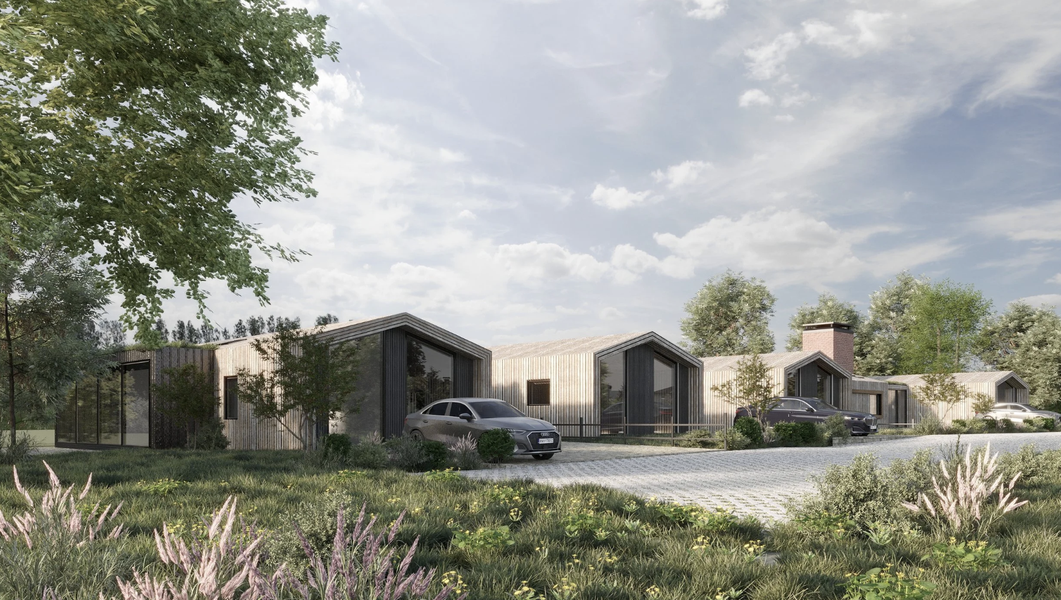
“I love being the client, architect and developer”
“I always saw architecture as my route to development,” says Andrew Edwards, EDG:Architecture
In 2019, Andrew made a clean break with his former practice to try and create his own identity in the industry. He and his wife, Charlotte, are the directors of EDG, but Andrew is the only one with a background in architecture. The decision to start a practice with only one design director has shaped the practice and provided some of Andrew’s deepest lessons as an architect and a business owner. “It is one of my biggest regrets and learnings, going it alone. You miss having that person to bounce ideas off of, share workload, and just sense-check you. I’m lucky to be part of a networking group of peers who are in leadership positions in their respective industries; I really value that.”
The biggest challenge that Andrew has faced in EDG’s six years in business was a computer hack that took the practice nine months to recover from. “It was a random hack by a North Korean group. It got in through our router, bypassing our antivirus, and then sat there trying to break our VPN [Virtual Private Network] and server passwords. We don’t know if it was there for a single day or three years. There was nothing more we could have reasonably done to prevent it. We came into the office after a bank holiday weekend to find malware in the process of encrypting every single file on our server. We spent the morning grabbing files onto our desktop before they could be compromised.
“We then spent the next month trying to figure out which file related to which project. We had hundreds of them with the same name - ‘existing plans’ for example - to sort through and assign. We then had to add files from our manual back-up four weeks earlier for the projects that were compromised. But we also had to go through every one of those projects to figure out what drawing we had worked on, what bit of that drawing we had changed, and then track back every single bit of work we’d done in the past four weeks and redo it from scratch.”
Andrew estimates that the hack personally cost him about £50,000. “Not only were we unable to bill for several months, we also had to pay for legal support and specialist IT support through our insurer before we could be reimbursed. And then, only if it was found we were not at fault.”
EDG has also changed to a Microsoft backup system where the practice can back up to any point in time. “It’s more expensive, but worthwhile for peace of mind. We’ve also changed our file-naming protocols; every file now has the project number in the name.
I honestly lost my passion for architecture in the following months, and it had a huge impact on my personal life and marriage. It’s one of the main reasons we decided to restructure and scale right back at the end of 2024.”
The practice shifted from a team of six down to just two full-time staff and one sub-contracted Architect. They transitioned to a home office, and they’ve since found a better balance. “Our contractor and third team member, Asela, moved back to Spain where she still does the bulk of the drawing work; I do all the client-facing tasks and business development.
“Because we have fewer staff and lower overheads, we need less work, which means we can be much more selective about what projects we take on.” We also raised our fees and let our conversion rate drop, allowing us to earn as much or more with a smaller workload. We’re able to give clients better service as a result.”
Diversification is what saved him, Andrew says, during a precarious time after the hack when EDG’s future was uncertain. “If we had not had alternative sources of income from our buy-to-let or serviced accommodation, then I don’t think EDG would have survived after the attack. They allowed me to keep paying the team, whilst taking nothing out of the business for myself.
“I always saw architecture as my route to development, which I think is my real passion, and since we restructured I’ve been spending more time on that side of the business. “We’ve partnered with a builder and a current client to do our own developments and have just bought our second development site. This one is for five new builds; the first was for seven.
“I’ve also partnered with a planning consultant on a joint venture to approach landowners with a view to obtaining consent on their land and buildings. This is more focussed on planning gain as opposed to development. We sell the sites with planning to developers and take a cut instead of a fee. I’m enjoying what I do again.”
For others who are making a start in the industry, Andrew’s advice is simple: “Know your worth and start with your fees at the level you want them to be at in five years’ time. Don’t try to win every job - take the right job at a distance, rather than the wrong job, locally.
Since restructuring, I do a lot less project admin and we’ve started pushing our services to help manage projects on site. Our margins have more than doubled since we made the change.
It’s also improved my personal life. I work less in the evenings. I’m less tired and more enthusiastic with the kids. I see Charlotte more and we will regularly take a morning off to go on a walk or spend time together. I have no regrets other than that we had to move on staff to do it.”
EDG has recently set up Form + Faber Ltd, a design and build firm for new-build homes. “Form represents the design, and faber is Latin for craft,” Andrew says. “We absorb the design fee into the project cost to reduce the client risk and design to the client’s budget with our in-house contractor. It’s no longer a linear process where you get planning, then tender, then look to make savings, then go back to planning for amendments and so on. It’s much more collaborative.”
As he looks to the future, Andrew is excited to continue pushing the development side of his work. “It gives me a buzz again that I’ve missed. I’d also like to take our work international and design luxury villas, and I’m eager to build Form + Faber as a business. We’re planning to document our journey, from purchase through to completion, on Instagram. We hope people will join us there and follow along.”
To learn more and connect with Andrew, visit https://www.edgarchitecture.co.uk, check him out on LinkedIn, and follow EDG:Architecture and Form + Faber on Instagram.
