“It’s really hard to accurately predict how wind will interact with a façade over time,” says Shane
Standard wind testing can have limitations, Shane says, particularly when it comes to replicating the wear and degradation a façade experiences over time. “This is why we’re building a giant gust generation device in our existing wind tunnel to test the impacts of many wind gusts in an accelerated and controlled manner.” Insol’s industry-leading, high-powered wind tunnel facility - the only one of its kind in the Southern Hemisphere - enables their team to test 1:1 scale models of façades in wind velocities of 180 kilometres per hour. With the new gust generation capability, Insol will be better equipped to create and test façades in a range of wind conditions.
“Our gust generation device has been developed in response to designs and façades becoming more complex,” Shane says, “as architects and creatives continue to push the boundaries of what’s possible. With it, we can do a 1,000-gust test which simulates 1,000 three-second gusts, replicating in just a couple of days the effects of what a façade might experience over 10-15 years. This allows us to test degradation in a short period of time and predict the long-term impact of many wind interactions.”
There are a number of use cases where gust testing is particularly beneficial, including sliding and bifolding screens, or any design that’s complex or hard to simulate with a 3D model. “Bifolding screens will experience multiple wind gusts each day; with the gust generation device, we can study the impact of that over time. We’re also seeing the need for gust testing for kinetic façades, which have individualised elements that are designed to produce a rippling effect as wind travels across the building. In designs like these, the moving parts will degrade and wear over time. Gust testing enables us to predict how that will play out. We haven’t seen much of this design style yet in New Zealand outside of public art installations, but there are a couple of kinetic building projects in the concept stage that we’re looking forward to.”
Globally, kinetic design is already gaining traction, Shane says, with a number of high-profile projects completed in recent years. “We’re currently performing testing for an exciting large-scale infrastructure project in the Middle East that includes kinetic design elements. The façade has panels of about one square metre, and the pivot system was designed to control the motion and prevent too much unwanted movement beyond a certain point.
“As true proof of the saying ‘engineering is the science of making microscopic calculations based on the vaguest of assumptions’, once we turned the wind on the large petals, they didn’t move at all due to the way the wind wrapped around the shape, rendering the previous pivot design almost worthless. We’re now working on an updated system that will fulfil the architectural intent and vision and operate as intended, testing and verifying as we go.”
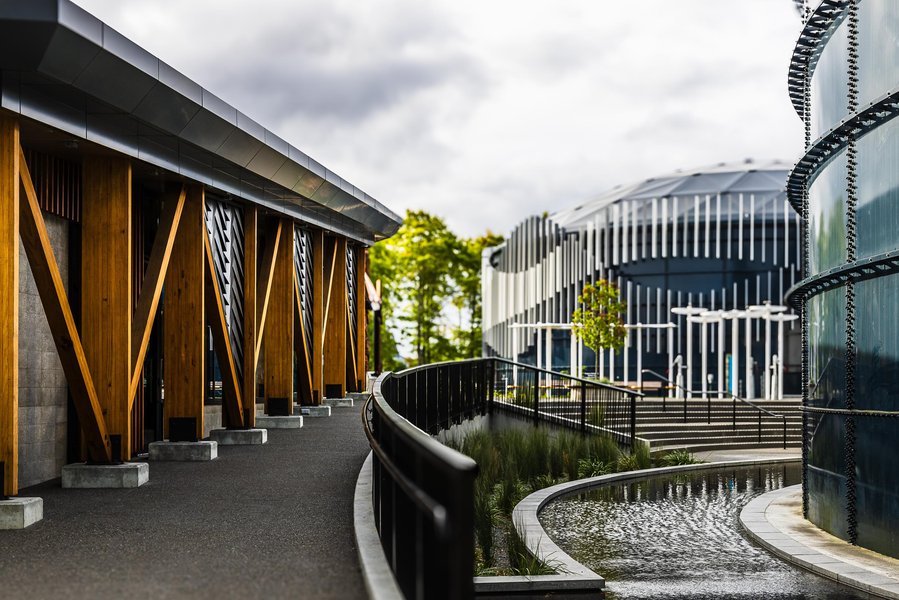
At home in New Zealand, Insol has recently completed work on the Koawa Studios building at the University of Canterbury, which opened in December. “This is a state-of-the-art 1,400sqm building with a striking façade made from over 700 triangular perforated metal leaves,” Shane says. “It will house advanced post-production facilities, editing suites, production offices, a screening room, and a 440sqm sound stage. A landmark around the campus for the future, the façade has been tested in Insol’s wind tunnel to ensure it doesn’t rattle, vibrate or whistle in any wind direction, including Christchurch’s notorious nor-wester. It is finished with a custom powder coat and a beautiful niho taniwha perforation pattern designed by Hori Te Ariki Mataki and the Ariki Creative whānau. The finished result is a true testimony of the collaboration between Insol, the contractor Southbase, and the architect Ignite.”
Looking ahead, Shane and the Insol team continue to expand their presence internationally through projects including the ongoing wind testing of fins for the US Consulate building in Rio de Janeiro and their kinetic design project in the Middle East, while also maintaining a high level of interest in the details of domestic projects. “Recently, we’re doing more work with bespoke elements like signage that is integrated into façades, which we did at Koawa Studios, but we also love doing more traditional projects like the one we recently completed at Northcote College in Auckland. This included a whole lot of louvred sun shading, really showcasing what you can do with that classic element in a school environment.”
Shane is currently preparing to deliver Insol’s upcoming Teulo Talks Lives sessions in Wellington and Auckland, where he’ll share additional background about these projects and dive further into the technical detail. “I love creative projects, which are a puzzle involving equal parts architectural design, façade engineering, and construction and manufacturing know-how. The challenges are where the Insol team really shines, and we’re excited to share our learnings with the architecture and design community.”
To learn more and connect with Shane, visit https://www.insol.co.nz/, sign up for their newsletter, and check out wind-tunnel testing videos and live updates on their LinkedIn