“My practice focuses on benefitting the human experience,” says Giles Miller, Director at Giles Miller Studio in London. “The way we do that as a team is to create impactful artworks and architectural interventions that lift a viewer’s spirits, bringing calm and evoking sensory and emotional stimulation through our intricate material compositions.”
“Curiosity and experimentation are central to everything we do.”
Giles Miller Studio
Since founding the studio in 2011, Giles has brought his skills as an artist to a diverse portfolio of projects that highlight surface, structure and sculpture. “All of our work has a richness through its complexity. We combine digital design and fabrication methodologies that enable us to control masses of components within each artwork with a hand assembly process that bridges the technology with craft.”
“Digitally, tools like Rhino and rendering software help us refine and communicate ideas, but they’re always grounded in physical prototyping,” says Lead Designer, William Lee. “Intuition plays a key role alongside technical rigour; there’s a constant back and forth between controlled design and allowing the material to lead.”
The result, Giles says, is “a kind of engineered artistry that defines all of our projects, be they tiny sculptural jewellery or murals that span multi-storey buildings. The diversity of scale in which we are able to work fuels new dimensions and considerations that can then inform alternate scales or applications, so we have a kind of circular flow of artistic inquisition which expands what we do in increasingly varied directions. I love the fact that we are able to experience working in such a rich array of areas, scales, continents even.”
The collaborative aspects of the work allow Giles and his team to take abstract ideas and evolve them through dialogue, testing, and shared exploration. “That process of dissecting and rebuilding a concept often leads to outcomes that go far beyond the original brief,” William says. “Each project becomes a unique mix of perspectives, constraints and opportunities. Rather than imposing a fixed vision, we allow the work to develop organically, responding to the site, the material, and the people involved.
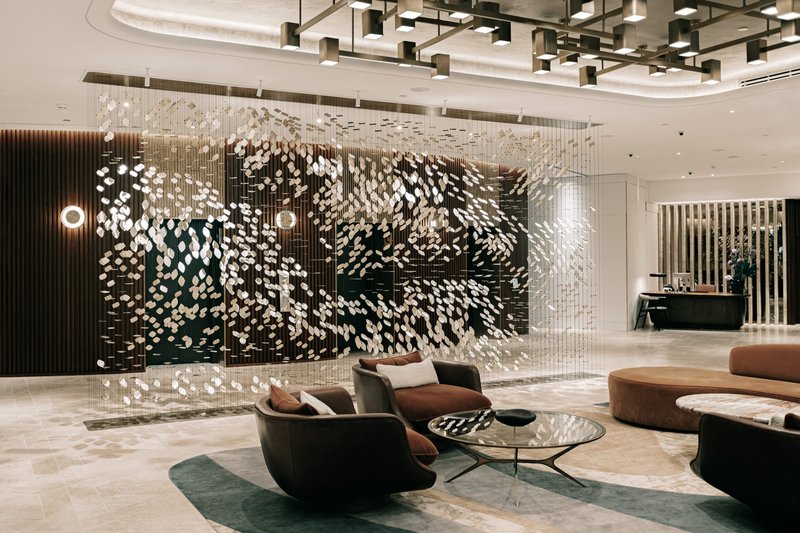
“We’re not tied to a single material palette. Instead, we work across metals, papers, woods, and ceramics, selecting what feels most appropriate for the concept and context. What unifies the work is a focus on repetition, aggregation, and subtle variation, principles that allow simple elements to build into complex, expressive sculptures.”
Edvinas Bruzas
Artwork is approached as a dialogue between material, environment, and human perception, William says. “Increasingly, our work is informed by principles drawn from neuroscience, particularly how people instinctively respond to texture, pattern, light and movement. Rather than seeing our installations as static objects, we think of them as dynamic systems that interact with their surroundings and the people experiencing them.”
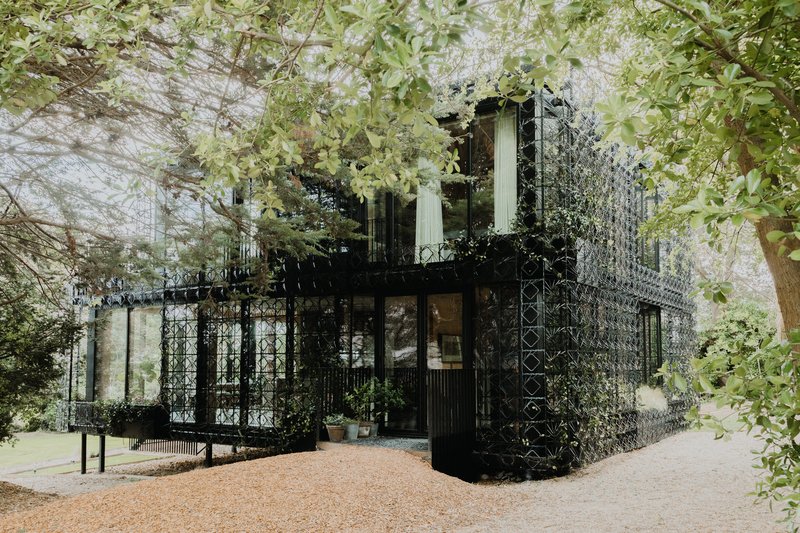
This approach was inspired by an experimental residential house build that the studio undertook from 2019-2022, Giles says. “The exterior was glazed, and a sculptural façade brought climbing plants into the house, visually breaking down barriers between the inhabitants and the house’s natural surroundings. Since that project we have been researching the neurological impact of our artworks and allowing that to inform our evolution as a studio.”
Their belief, they say, is that sensory engagement can foster deeper connections between people and spaces. “By embedding this thinking into our process, we aim to create environments that feel alive: responsive, immersive, and intuitively understood rather than overtly explained,” William says.
Giles Miller Studio
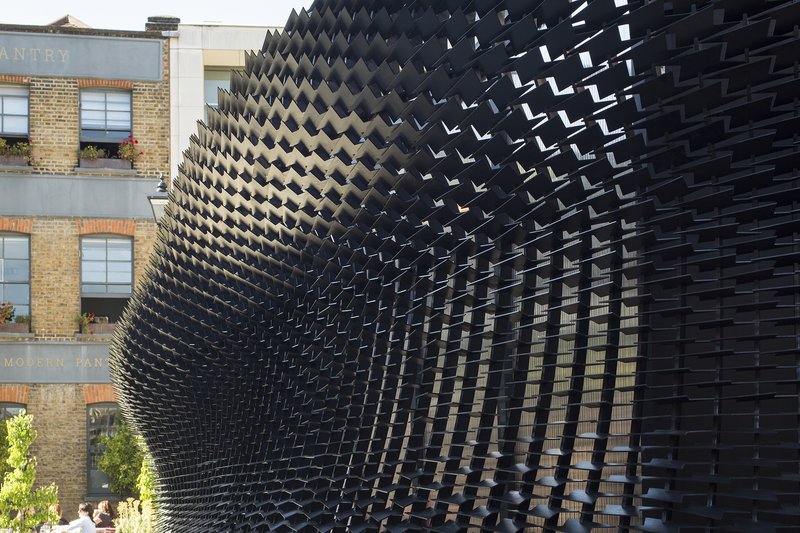
Many of the studio’s core values are on full display in BBC Pavillion, a large-scale installation that operates simultaneously as architecture, artwork, and functional space. “What makes this project particularly compelling is how it brings together expressive form with responsible material thinking, designed to be recyclable while still delivering a powerful visual and spatial experience,” says William. “The pavilion demonstrates how sculptural language can extend beyond gallery contexts into public-facing environments, engaging a broad audience. Collaborations like this are important because they allow us to test ideas at scale, exploring how the studio's unique design approach can contribute meaningfully to cultural and public spaces while maintaining a strong artistic identity.”
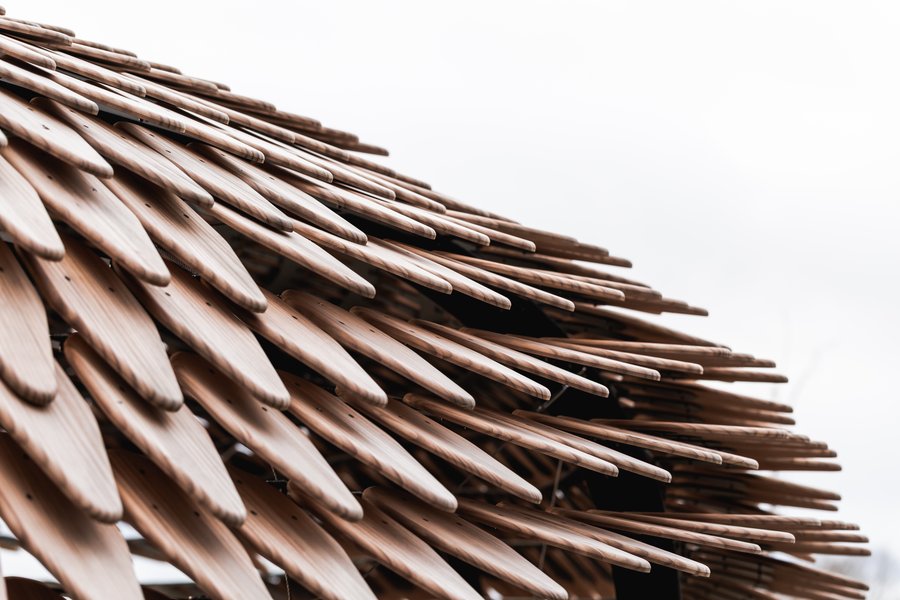
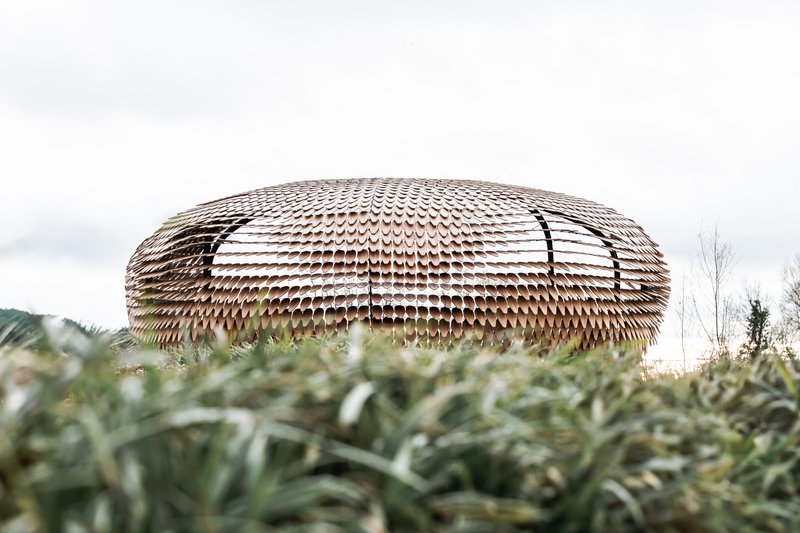
2025 project Eyrie builds on these ideas in a sculptural oasis in Reading, UK, where residents and visitors can find a sanctuary for calm and quiet contemplation. “Eyrie combines the beauty of natural timber with a sculptural composition that bridges engineering and the natural world,” Giles says. “It’s the relationship between nature and our built environments that is a particular fascination of mine, and the project sits to bridge the two in a functional and also evocative way.” Eyrie’s pinecone-like exterior, made of thousands of custom-designed Abodo timber shingles, offers a living, tactile experience that “invites visitors to engage with the structure as they would with the natural world - through exploration, curiosity and touch. Abodo’s material enabled us to perfectly deliver a beautiful ambassador for nature, but in a sustainable way that has true longevity.”
OLCO Studios
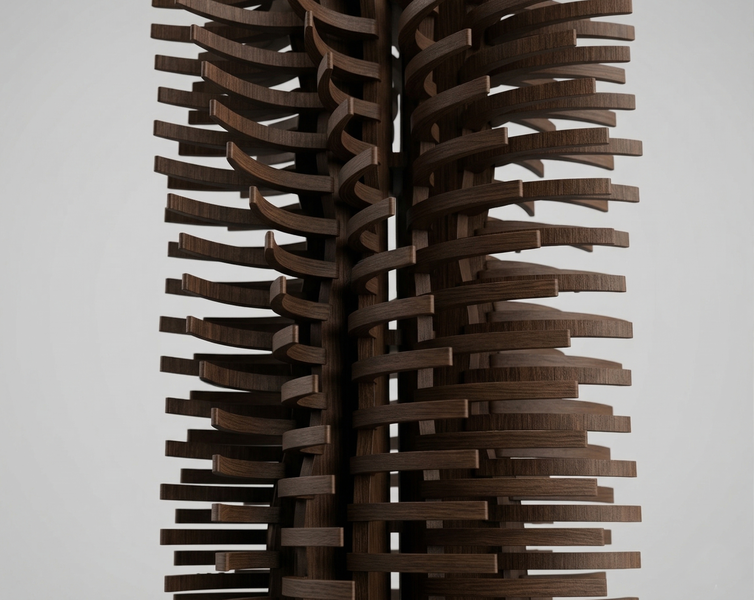
Giles Miller Studio will be featured in the upcoming London Festival of Architecture programme through Teulo’s Forest of the Senses event that sees Reddie’s Clerkenwell showroom transformed into a sculptural forest. “Forest of the Senses is conceived as an immersive, multi-sensory installation that reconnects visitors with the full spectrum of human perception,” William says. “Our role has been to develop a sculptural environment using Abodo timber, creating abstracted, tree-like forms that visitors can move through and experience spatially.”
The installation, designed to be both visually striking and physically engaging, invites attendees to touch surfaces, explore textures, and investigate the craftsmanship up close, William says, creating a more immediate and personal connection to the material. “This is complemented by a layered sensory experience: an atmospheric soundscape, produced by MindFidelity, is inspired by forest rhythms; scent elements by Dulcie evoke memory and place; and curated food and drink extend the experience into taste. Together, these components form a cohesive environment that blurs the boundaries between art and nature. It’s about slowing people down, heightening awareness, and encouraging a more intuitive, embodied way of experiencing space - what we think of as sensory artistry.”
This sensory extension is uncharted territory for the studio, Giles adds. “It’s the first time we will be collaborating to expand the sensory impact of the pieces by introducing sound and scent to the experience. It’s a very exciting moment for us, and we hope that it will be the first step in a new direction which encapsulates more for the viewer than ever before in terms of the positive impact of the work.”
As the team looks ahead, they are deepening their research into the neurological impacts of their work to understand more clearly how they can influence wellbeing and perception. Additionally, they are growing their portfolio of public art projects to increase opportunities for people to engage with and benefit from the studio’s work in their everyday environments. “I am working on several smaller works which are self-directed,” Giles says. “Many of our projects are increasing in scale and those are some of our most exciting works, but they are also inevitably commissioned, and within that is a set of parameters. I am enjoying material investigations in my studio which are spawning new, smaller-scale artworks which could be bought directly by a consumer, and this brings a freedom which is fresh for me and for our team as those new ideas feed into our larger works.”
“We’re really encouraged by how people are engaging with the sensory and neurological aspects of our work, and we’re keen to continue building that conversation,” William says. “As research in this area develops, we see an opportunity to deepen understanding of how art can positively influence people and spaces. Ultimately, our aim is to grow a community that recognises the value of art not just as something to observe, but as something that can actively shape how we feel, think and experience the world around us.”
To learn more and connect with Giles Miller Studio, visit https://gilesmiller.com/, follow them on Instagram and Pinterest, LinkedIn and register now for Forest of the Senses on the 4th of June.
Giles Miller Studio
