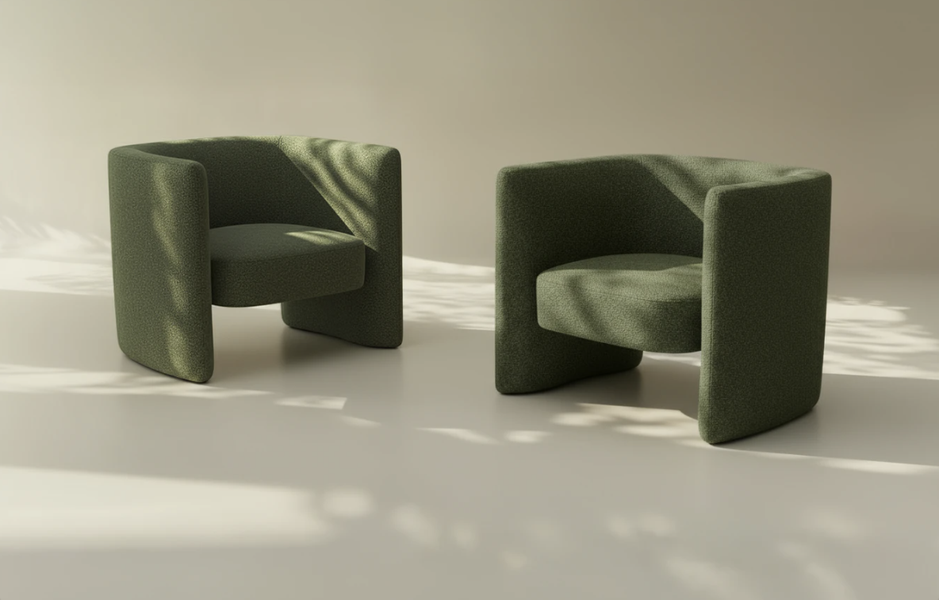
From their offices in Auckland, Sydney and Paris, Renoir boosts visibility for architects, product manufacturers, and design houses by producing stylised photos and video clips. “Arranging photoshoots is very expensive, complex, and time-consuming,” Claude says. “By using Renoir, you can streamline that process and showcase your work in the best possible way.”
The goal, he says, is to translate their clients’ vision into a visual experience. This process might involve providing Renoir with a single product image, 3D assets, architectural drawings, or floor plans. Claude, his Co-Founders Claudio Pertusati and James Li, and their team then take the source content and transform it into in-situ lifestyle videos and images that match the local architecture, context and landscape. “For architects, one of the big challenges is convincing clients that they want renders, as these can be very slow and hugely costly to produce. This means that amazing imagery is something that is often reserved for special occasions or high-end projects, when really it should be available for all. With Renoir, architects and suppliers can produce beautiful, precise imagery for any project in an efficient and cost-effective way, and companies can command high rates thanks to premium visual assets.”
The recipe that makes this possible is a combination of Renoir’s proprietary AI solution, time-tested design tools, and deep industry experience. “AI brings speed, but it can’t yet match the craft of traditional industry tools, so it’s really important to use these emerging technologies in tandem with established design platforms and human expertise.” It’s this best-of-both-worlds approach that inspired the name Renoir, as he was an avant garde painter who embraced technological developments and used them to serve his art with vivid colours and textures. “When used correctly, that’s exactly what AI can do.”
Claude’s background as an AI engineer and his family’s involvement in the building industry have both inspired and informed the trajectory of Renoir. “I’ve been working in AI since before it was cool,” he laughs, “and design has always played a big role in my life. My family is involved with very high-profile construction projects, including La Défense in the business district of Paris. For many years, I have watched their passion for their craft - carefully selecting suppliers and sourcing the best products and designs - but I have also seen them struggle to showcase their work, with customers not understanding the nuance of what they’re trying to achieve. I remember telling them that they should just take photos and put them on their website, to which they responded that they’d have to wait five years before they could do that - what were they supposed to do in the meantime? This is a real struggle for many architects who, in some cases, can’t even access the site of the thing they’ve spent years working on until it’s fully complete. That idea stuck with me for years as I was learning and building my career as an AI engineer. I used it as inspiration when when we launched Renoir, and took that opportunity to develop my design eye and create a platform that is solving real challenges across the building industry.”
Architects want and need precision in their imagery, Claude says, but high precision means more time and more money; many will opt not to have visualisations at all, rather than creating something that’s not doing the job accurately. From the product side, it’s a struggle to get seen, with specifiers reviewing dozens of potential suppliers at once. “It’s easy to get lost in that due diligence process; your product needs to stand out immediately. And for architects, it can be a real challenge to translate their vision for potential clients. That’s why we’ve doubled down on video production. This helps us to capture the nuance of design in a way that’s easily understandable and shareable - zooming in and out and focusing on specific elements. What we’re doing, I think, is solving the ‘last mile’ problem for architects, designers and manufacturers by taking them that final step on the journey from idea to sale.”
During his eight years in New Zealand, Claude connected deeply with the Auckland architecture and design community; through those relationships, he has built a team of 3D artists, AI specialists, and local design and building experts. “Our team averages a decade of industry experience, and they have used their expertise to train our AI software on thousands of products and inputs,” he says.
This approach has enabled Renoir to create detailed, locally relevant imagery for established New Zealand suppliers including Belcanto and Archer Concepts. “Belcanto has amazing balustrades and balconies - a booming market in New Zealand as the building industry transitions into higher-density housing. But these are the last installation in every build, so it can take years for their work to be realised. Renoir enables them to visualise their products in different environments and use cases, without having to wait for those real-world projects to be completed. On the interior design side, Archer is a commercial furniture company that sells to hotels, restaurants, and retirement villages. They’re in the process of rebranding their entire group, and we’re helping them to demonstrate that their products can be used effectively in a range of different places and contexts, including luxury and high-end environments.”
For both suppliers and architects, Renoir provides opportunities to realise elements that don’t exist yet. “This has become the number one reason people want to work with us,” Claude says. “For instance, if we are working with a furniture company on a pre-launch product, we can produce static imagery of ideas that haven’t even made it off the production line yet, which the client can then use to boost pre-sales. We can do the same for architects by creating imagery of their design concepts without the need for them to do a costly render first. We’re able to make their vision real, which our clients find very exciting. And they can then reallocate the time and money resources saved by using Renoir visualisations - which are sometimes significant - to other project essentials.”
Another area where Renoir can offer significant value is in unrealised projects, Claude says. “Imagine you run an architecture firm and you work so hard to pitch this amazing idea, but you’re one of 20 firms competing to land it. If it’s a big project, you invest a lot of time and resource into pitching it, but then 19 out of 20 firms don’t land the deal. These are often very viable, high-quality projects that maybe just missed the mark by a few thousand dollars or a couple of weeks. With Renoir, those unrealised projects don’t have to become lost projects, because you can repurpose them and showcase them to other leads.”
Claude has recently moved back to Paris and is excited to grow Renoir’s presence in the UK and European markets in the year ahead. “We’re already well established in Australia and New Zealand, and we’re expanding our footprint further into Europe in 2026; this will be a big focus for us moving forward.” The team is also preparing to launch a new self-service offering which he hopes will expand their reach to smaller firms and manufacturers. “Our client base currently is premium, luxury brands who we work with on bespoke visualisations, but Renoir’s new self-service option should allow any firm, including smaller and newer businesses, to create detailed imagery that they might not otherwise be able to afford.
“Another development that will be of particular interest to architects is our virtual walkthrough, which will enable users to experience a space room by room, setup by setup. All the architect has to do is provide a floor plan, and then we can create a totally accurate walkthrough of every room. That’s a complex challenge with many layers, but it’s something we’re actively working on at the moment that we’re really excited about. Ultimately, we are a creative team that believes that capturing attention and showcasing our clients’ work is a creative activity. That’s just how we view the world.”
To learn more and connect with Claude, visit https://berenoir.com/, Book a Demo, or follow Claude on LinkedIn.